

The Most Efficient Way to Learn SQL in 2025
Stop watching tutorial after tutorial

SQL is a vital skill for anyone working with data, but starting can feel overwhelming.
What should you learn first?
How do you avoid common pitfalls?
As someone who started learning SQL from scratch, I’ll share the most efficient way to get up and running with SQL.
Let’s break it down into practical, detailed steps that will take you from beginner to confident analyst.
Here are the steps we’ll cover:
What SQL is and why it matters
Choosing the right environment
Mastering the fundamentals
How to improve
Going beyond the basics
Let’s get started.
Step 1: Understand What SQL Is and Why It Matters
SQL, or “Structured Query Language,” is the language of databases.
It’s how we communicate with databases to retrieve, update, and manage data efficiently. Whether you’re analyzing customer feedback, tracking product performance, or managing massive datasets, SQL makes it all possible.
Though coding seems scary, SQL is surprisingly intuitive once you get the hang of it.
When I ran my first query and successfully retrieved data, I was hooked. I was blown away by how simple it was. As a result, I was empowered to continue.
Why Learn SQL?
It’s Universal: SQL is here to stay. It's used across tons of different industries and roles, making it a versatile and enduring skill.
It Drives Insights: SQL helps you uncover trends and inform decisions by querying and organizing data.
It’s Intuitive: SQL syntax is intuitive, making it very approachable.
Example:
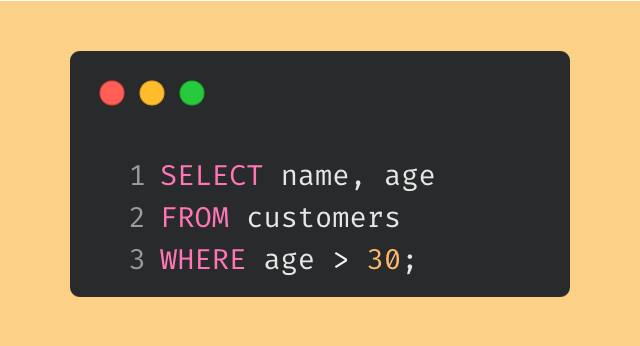
This query says: “Show me the names and ages of customers older than 30.”
Easy, right? But the real value lies in understanding how to adapt this structure to complex business questions.
Step 2: Choose the Right Environment
SQL doesn’t exist in a vacuum. You’ll need a Database Management System (DBMS) to practice. Here are some options:
PostgreSQL: Open-source, powerful, and widely used.
MySQL: A beginner-friendly and popular choice.
SQLite: Lightweight and portable, great for small projects or learning.
If you prefer not to download anything, cloud-based options like AWS, Google Cloud, and Azure are available with free tiers.
If I were starting from scratch, I’d recommend PostgreSQL or MySQL. Both are widely used in the industry, have excellent documentation, and provide a strong foundation for learning SQL. PostgreSQL is often favored for its advanced features and adherence to standards, while MySQL is popular for its simplicity and speed.
That said, cloud-based SQL flavors like Google BigQuery offer significant benefits, especially for handling large-scale datasets and leveraging cloud-native features like on-demand scalability. Exploring these options can be valuable as you advance in your SQL journey.
Ultimately, it doesn’t matter much which one you choose when starting out. The goal is to familiarize yourself with SQL fundamentals. Pick one and get going!
Pro Tip: It doesn’t matter which DBMS you pick initially. Focus on learning SQL fundamentals, as syntax differences between platforms are minimal.
Step 3: Master the Fundamentals
SQL can feel overwhelming with its many commands, but mastering a core set of concepts will cover 90% of what you need to know. Here’s what to focus on:
The Big Six: These six SQL keywords form the backbone of any query:
SELECT: Specify the columns you want to retrieve.FROM: Identify the table(s) to query.WHERE: Filter rows based on conditions.GROUP BY: Group rows to perform aggregations on subsets.HAVING: Filter grouped data after aggregation.ORDER BY: Sort the results.
Example:
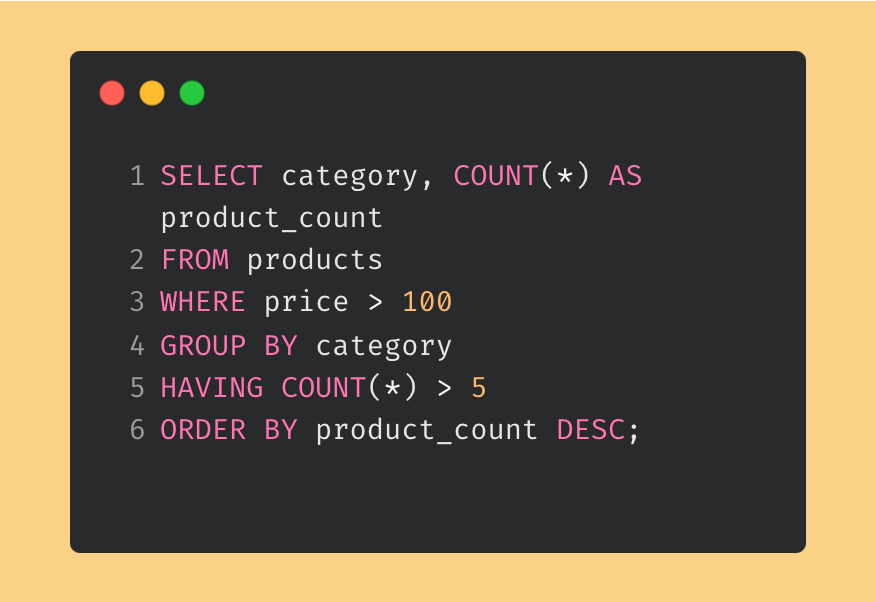
This query retrieves product categories with more than five items priced over $100, sorted by the number of products in descending order.
JOINs: Combine data across tables to find relationships:
INNER JOIN: Returns rows with matching values in both tables.
LEFT JOIN: Includes all rows from the left table, with
NULLfor missing matches in the right.RIGHT JOIN: Includes all rows from the right table, with
NULLfor missing matches in the left.FULL OUTER JOIN: Includes all rows from both tables, filling in
NULLfor unmatched rows.
Example (INNER JOIN):
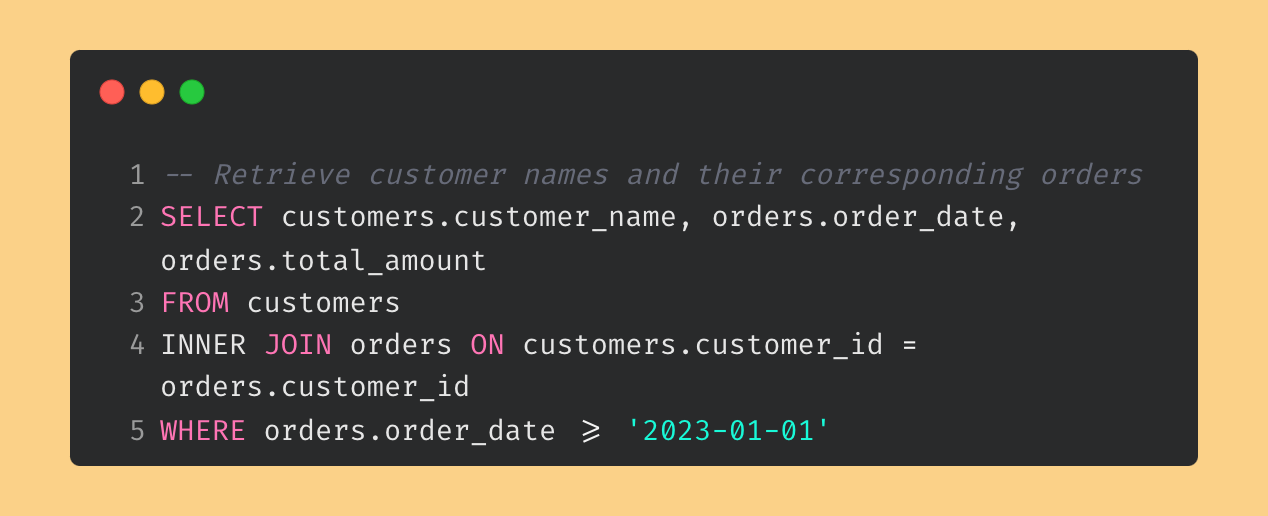
This query finds customers who placed orders worth more than $500, showing their names, order IDs, and total amounts.
Pro Tip: Practice hands-on with real or sample data. Start with simple queries, then experiment with JOINs and the Big Six to handle more complex scenarios.
Step 4: Build Confidence with Real-World Scenarios
Learning SQL in context, rather than through isolated syntax, will deepen your understanding and retention. Start with familiar datasets, like personal expenses or sales reports, and answer real questions:
How much did I spend on dining last month?
What are my top 5 highest-paying clients?
Which regions have the highest sales?
In other words, start creating some personal projects and getting your hands dirty with data!
Implementing SQL in Your Workplace
SQL is not just for hypothetical scenarios; it has massive real-world value. Here are some practical ways to apply SQL at work:
Automate Reports: Use SQL to pull recurring metrics like weekly sales or customer engagement trends.
Data Cleaning: Write SQL queries to filter, update, and structure raw data for better analysis.
Team Collaboration: Share query results with your team to ensure everyone has access to consistent, reliable data.
Quick Insights: Instead of waiting for a BI tool update, use SQL to directly query databases and answer urgent business questions.
Get connected to your companies SQL database and start making moves!
Example:
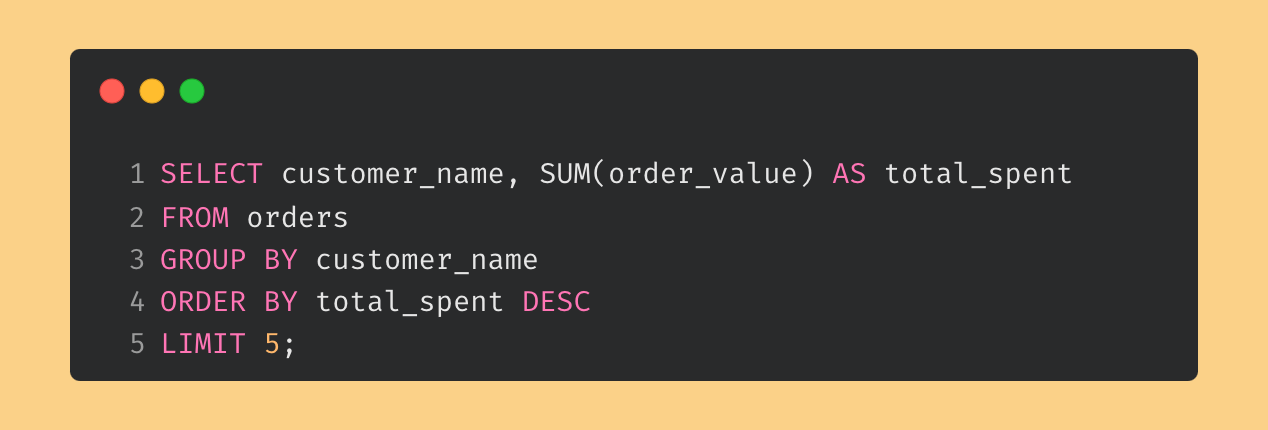
This identifies the top 5 customers by spending.
Practice Makes Perfect
Consistent practice is key to mastering SQL.
Websites like HackerRank, LeetCode, Mode Analytics, and DataFord offer SQL problems tailored for beginners and experts alike.
DataFord, in particular, focuses on SQL practice designed for data analytics jobs specifically, making it an excellent choice for those targeting this career path. Commit to solving at least one problem a day.
Pro Tip: Schedule 15 minutes daily to tackle practice problems. Over time, this consistent effort will build your confidence and proficiency.
Step 5: Go Beyond Basics with Advanced Features
Once comfortable with fundamentals, explore advanced topics to elevate your SQL skills:
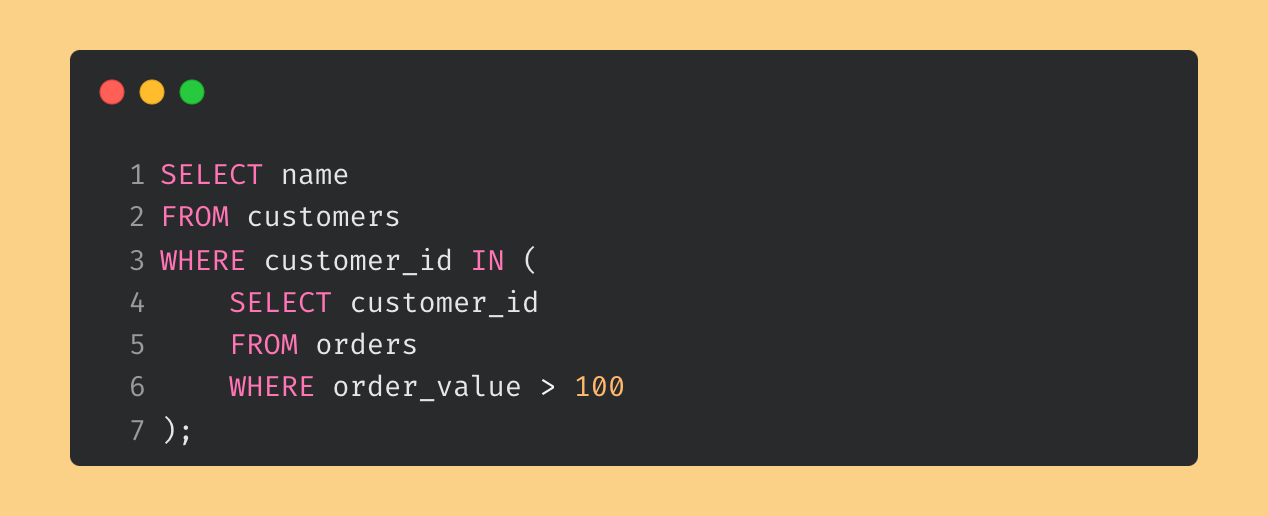
Subqueries: Queries within queries that help break down complex problems by allowing you to isolate and solve smaller parts of a larger query. Subqueries are especially useful when you need intermediate results or want to perform filtering, aggregation, or complex comparisons before integrating the data into a final query.
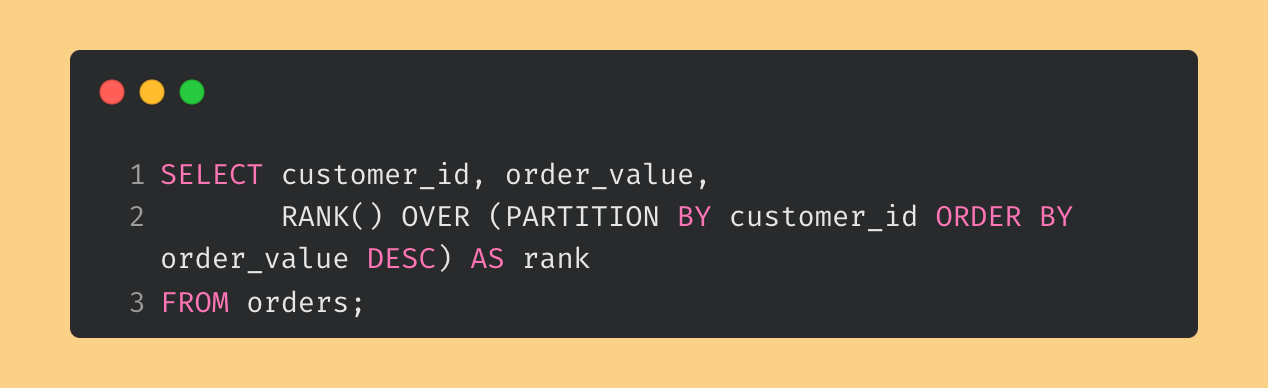
Window Functions: Perform calculations like rankings, running totals, and percentages without grouping data. They are implemented using the
OVERclause, which allows you to define a window or subset of rows within a dataset for the calculation.
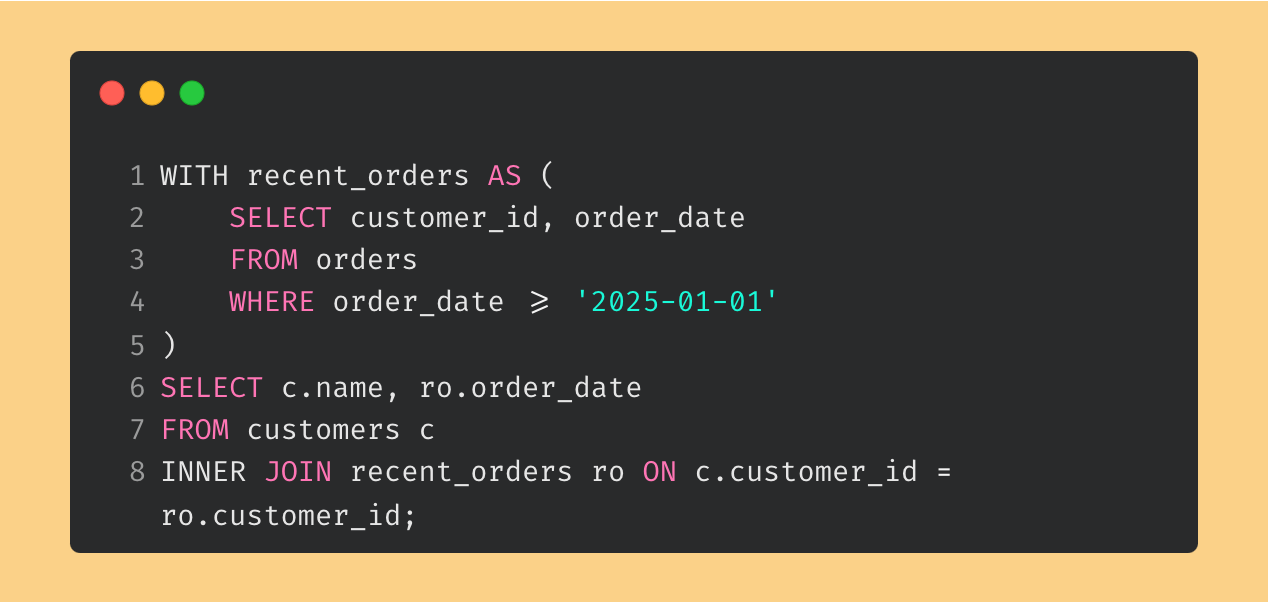
Common Table Expressions (CTEs): Simplify complex queries by breaking them into reusable components. CTEs are particularly useful when you need to organize and structure queries in a readable and maintainable way. They allow you to define a temporary result set that can be referred to within the main query.
SQL Is a Journey, Not a Sprint
Learning SQL is about consistency and application. Don’t rush to memorize everything. Focus on solving real problems. Over time, you’ll build muscle memory and intuition for writing efficient queries.
Next Steps:
Set Consistent Goals: Dedicate at least 15 minutes a day to SQL practice. Consistency trumps intensity.
Learn by Doing: Apply SQL to personal projects or datasets that interest you. For example, analyze your favorite sports team’s performance or your budget data.
Track Your Progress: Keep a journal or document of the queries you’ve written and problems you’ve solved. Over time, you’ll see just how far you’ve come.
Why SQL is Worth It
No matter where you are in your career, SQL is an incredibly valuable skill.
It’s a gateway to understanding and working with data. It’s a skill that’s in high demand across many industries. Whether you want to be in data or even project/product management. From the fundamentals to advanced functions, there’s always room to grow and improve.
If you’ve been putting off learning SQL, start today. Your future self will thank you.
2 More Ways I Can Help You:
1:1 Coaching Call - Looking for advice on the data job hunt? Need someone to review your resume or portfolio? Want help with mock interviews? Whatever it is, let’s chat. I’m here to help. Book a call here.
4-Session Coaching Program - Looking to land your first job in data? I’ll cover everything you need to know and design a living, personalized roadmap just for you. I’ll also work with you until you get a job. Check it out.