

The 5 Trends Shaping How Top Data Analysts Work in 2026
The skills haven't changed much. The way they're being used has.

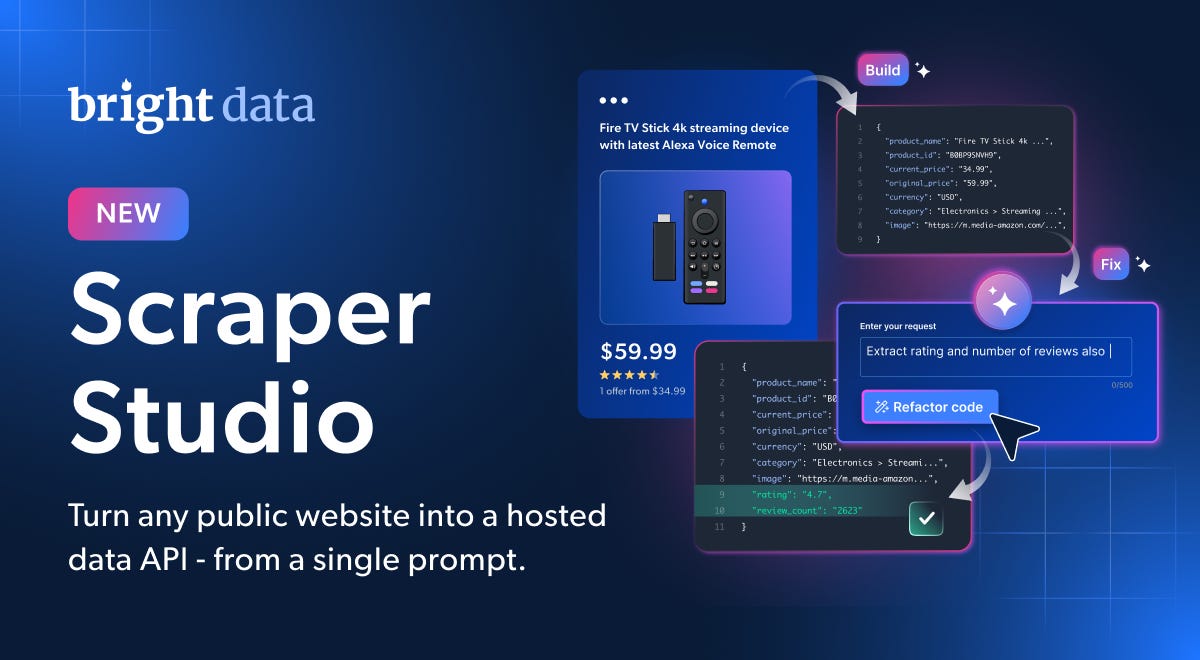
Sponsored by Scraper Studio
Build a working web scraper by typing one sentence
Scraper Studio turns any public website into a hosted data API from a single prompt, then patches itself when the site changes. 5,000 free credits every month, no card required.
Three years ago I was writing SQL queries from scratch almost every single week. Today I do maybe 20% of that by hand. Not because I got lazy. But because the job changed, and a lot of the analysts who are struggling right now have not caught up to it yet.
I just got back from a conference in San Francisco, and one theme kept coming up in nearly every conversation: the top 1% of analysts work nothing like they did two years ago. So here are the five trends I keep seeing.
Writing SQL 100% by hand is becoming the exception
Data cleaning is no longer where you spend most of your day
How you communicate the analysis matters more than the analysis
Your team’s AI is only as good as its shared context
Keeping your skills current without burning out
Let’s dive in.
1. Writing SQL by hand is becoming the exception
Think back to a normal workday about three years ago. How much of it was just writing SQL? For most of us it was somewhere between 50 and 80% of the day. AI has since automated roughly 30 to 40% of the tasks that filled a typical analyst week in 2024.
When ChatGPT first showed up, it was fun but mostly wrong. Ask it for a query and you were lucky to get something usable. Lots of iteration needed. That changed quickly (for the most part). By 2024 I was using it regularly to write queries, build formulas, and troubleshoot logic. Now I lean on it widely. Of course, you still want to validate every output.
LinkedIn’s Chief Product Officer, Tomer Cohen, has talked about tis. He says that technical work used to be about 80% execution and 20% strategy. For people and teams using AI well, that ratio is flipping to 80% strategy and 20% execution. That is honestly where my own day-to-day is heading, and it has let me make bigger impacts on my team much faster.
2. Data cleaning is no longer where you spend most of your day
SQL was one thing, but cleaning data used to eat just as much time, sometimes more. AI has created something close to an 80% time savings on data prep for most analysts.
If you have ever spent a full day untangling messy inputs and five different naming conventions for the same thing, you know the pain. I run into this constantly because a lot of my data is entered by individual operators in the field, and there is not always a standard in place. Even if we have clean Snowflake tables already made, there are certain columns that are inconsistent by nature, based on how they’re entered by field operators.
Now there are plenty of ways to speed this up. At my 9-5 it is GitHub Copilot, since that is what our organization runs on. On my own time Claude is my default. If your company is a Microsoft shop you are probably already doing the same thing, whether that’s Copilot in Excel, Copilot Premium, or GitHub Copilot. The specific tool matters less than the habit and your process.
The thing that makes any of them actually work for me is context. I create context documentation to train the AI, keep a data dictionary, and write report explanations so the AI understands my business and my data. Even then, it can confidently get things wrong, so I audit whatever it gives me. That costs a few extra minutes, and I am still moving faster than I would without it.
3. How you communicate the analysis matters more than the analysis
Sharing an analysis used to mean building the dashboard, sending the email, and then answering every follow-up question that came after. That loop takes forever. There are days where the way you frame the insight matters more than the insight itself.
A few ways I use AI here: distilling my analysis into key points, transcribing my notes so I have a repository I can talk to later, and drafting summary docs to get a presentation started. It is especially helpful when I need to explain something to a non-technical audience and want it to land in a sharper way.
The highest value work right now is framing the right questions, interpreting ambiguous data, communicating to stakeholders, and validating AI outputs against business reality. That is the part no tool does for you. These skills are becoming more premium than ever before.
4. Your team’s AI is only as good as its shared context
This is the most interesting to me, because it is not really about the data work at all. The bottleneck is quietly moving. A year ago the question was whether the AI could write the query, do the task, or ship the thing. Now it can. The new question is whether everyone’s AI is working from the same context, and most teams are nowhere near that.
Here is what I mean. My AI knows my slice of the project from the docs and notes I have fed it. My teammate’s AI knows their slice. Neither one sees the whole picture, so the build drifts. I cannot tell you how many times I have been two or three days into something when a stakeholder comes back and says, “Oh wait, that is not what I meant.” The requirements were in one doc, the diagram lived in another tool, and the real decision happened over Slack. None of it was connected, and none of it made it into the context my AI was running on.
The teams pulling ahead are the ones treating shared context as a deliverable, not an afterthought. And again, very few teams are doing this well yet. When the requirements, the diagrams, and the decisions all live in one place that everyone’s AI can actually read, you catch the wrong direction in the first conversation instead of three days in. That is the same context discipline from trend 2, just pointed at your team instead of your data.
5. Keeping your skills current without burning out
A few years ago, keeping up meant courses, certifications, and YouTube videos. That is all still true. What changed is how much of it is now about AI.
The skills themselves have not changed a ton. The way people get the most out of them has. Keeping up with every new AI tool can feel like a full-time job on top of your actual job. So here is what I would tell you: learning to use AI well in just a few ways beats chasing every new system out there.
It does not have to be complicated. It can be as simple as building context documentation or adding one tool that speeds up your workflow. The best habit you can build right now is consistent, practical application. You do not need to learn everything. Get better at a few things and actually implement them.
Wrapping up
So those are the five trends shaping our work over the next several years: less manual SQL, faster data prep, sharper communication, shared context across your team, and a smarter way to keep your skills current.
None of them are scary. The analysts who are struggling right now are not missing some magic tool. They are doing the job the same way they did three years ago while everything around them has changed. Pick one or two of these, put them into your week, and you will already be ahead of most people in the field.
Thanks for reading.
Until next time ✌️